The Talking Playhouse:
The Place for Social
& Executive Function Therapy
For Social Intelligence Therapy, Executive Function Therapy (including Anxiety Management & Self Regulation) and Social Pragmatic Language Therapy
Parents, Adults & Kids Learn Social & Executive Function Tools
OPEN ENROLLMENT: Summer/Fall/Spring
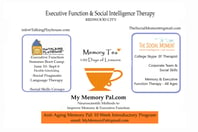
(Summer Preview on Postcard with tea cup above)
CUSTOMIZED CURRICULUM SPECIFIC FOR EACH CLIENT: SOCIAL SKILLS,SOCIAL PRAGMATICS, EXECUTIVE FUNCTION INCLUDING ANXIETY MANAGEMENT & ENHANCED MEMORY SKILLS.
EXECUTIVE FUNCTION BOOTCAMP (email for brochure)
WHERE REAL CHANGE HAPPENS EVERY DAY!
EMERGING BEHAVIORAL TECHNIQUES IN ANXIETY MANAGEMENT
Jenn Bulka has been teaching/coaching/training kids and adults for over 20 years!
Reduce Social Anxiety, Increase Social Communication & Social Connections
Create Winning Strategies for Your Executive Organizational Skills
Understand How to Develop Tools to Manage ADHD
Manage Self Regulations for Problem Solving
Master Pragmatic Language to Enhance People Skills, Writing & Problem Solving
Parent as Coach: How to bring up a social thinker! (starting in kindergarten)
Social Skills Groups & Individual Classes for Reducing Social Anxiety, Executive Function Therapy,
Improving Social Awareness & Connecting to others; ability to use Social Pragmatic Language Therapy to build community and Social Thinking.
ORGANIZATIONAL LIFE©
(Executive Function Hands-on Therapy)
SOCIAL SKILLS COACHING
EF Therapy for Middle & High Schoolers
EF Therapy Training
for Parents (including elementary school students)
Parent Coaching: Parent as Social Thinking Coach at Home
Therapy for Adults with ADD or ADHD
MIDDLE SCHOOLER BECOME SOCIAL THINKERS & BUILD COMMUNITY
ORGANIZATIONAL SKILLS FOR BRIGHT TEENS & YOUNG ADULTS
Please email info@talkingplayhouse with "MEET & GREET" in the subject.
Talking Playhouse: Social Skills Therapy, Executive Function, Parent Coaching
* * *
*ADDRESS: 156 Elwood St, Casita, Redwood City 94062 (near Sequoia High School)
SOCIAL SKILLS GROUPS - Children & Adults
Please see below regarding new client information. Then email "info@talkingplayhouse" with "Meet & Greet" in the title of your email with the information requested below. Please see below for descriptions of past therapeutic-based groups.
EXECUTIVE FUNCTIONING
Did you know that 'Social Learning' also includes Executive Functioning? Whether it's the choreography of the social encounter or getting systems organized for homework, activities of daily living, etc., it's all about organizing the brain! "EF Coach" is for parents and/or students. For more information please email: info@talkingplayhouse.com. Executive Function skills are best taught in real world activities. One of the best I’ve found is the college app process. If you are looking for support for your Junior, please email info@talkingplayhouse.com
TESTING FOR ADULTS & CHILDREN
Have you or your child been tested in the last three years? Testing includes expressive & receptive language, social thinking and social emotional behavior (including self regulation & problem solving), social & figurative language, writing, reading nonverbal cues and situations, auditory processing, understanding how we visualize to help with working memory & concepts for writing, executive functioning, teacher and parent interviews, goal development and how to be more successful with parenting and teaching that best suits your child's brain and learning styles. Please email info@talkingplayhouse.com for an appointment.
WRITING SENSIBILITIES
For students and adults with content development, pragmatic language and perspective taking challenges.
By appointment with 3 students max. (Ages: Entering 4 th grade through Adulthood-grouped according to age/ability.)
INSPIRATION SOFTWARE WORKSHOP COMING SOON in tandem with our Educational Therapist partner to understand how to think with organization that facilitates visualizing and ultimately writing and social choreography. (Stand by for dates and description.)
LINDAMOOD BELL'S® VISUALIZING & VERBALIZING®
Often times children and adults with social cognitive challenges will have difficulty with visualizing either during reading (characters, settings, social scenarios) which translate to their challenges in writing and social engagements. We will use specific techniques, customized for students with abstract thinking and executive function challenges, to comprehend more of what they read in order to facilitate their writing and conversation. Visual tools are used and curriculum is specifically designed to understand these challenges and guide students systematically through the process of abstract thinking and reasoning.
Please email: info@talkingplayhouse for more info.
PARENT COACHING TRACKS
Transition from High School to College to Adulthood.
How do I Manage the Classroom for Success with My Child?
Using Imagery to Successfully Change the Social Brain!
Adults: Making Life Easier (Social, Organization & Cognitive)
Sibling Therapy: Orchestrating Complicated Dynamics.
IEP Strategies for Success: Beyond the First Encounter.
What Does Multi-modal Learning Mean in Our Everyday Life & Systems?
Organized Systems that Work! (Logistical and Cognitive.)
Explaining to Your Child What Their Learning Difference Means.
Accomplishing Homework and Planning without Tears.
What's In Store that I can be Proactive About?
Writing: Why doesn't My Child Write More?
Getting Assistance & Support at Your IEP!
Schedules are subject to change, please mail for schedule updates: Email: info@talkingplayhouse.com
* * * * *
NEW CLIENTS
If you are a new client, please make a 30 min."meet & greet" appointment. See new client info needed below.
PLEASE SEE BELOW FOR REGISTRATION PROCESS BELOW.


HELPFUL INFO ABOUT THERAPY & CHANGE
How to develop new pathways in the brain when certain areas appear underdeveloped is a complicated and tedious road to hoe and yet it is one of the most life-rewarding efforts one can embark on. It takes courage, willingness, indefatigable effort, patience, and an inordinate amount of time and tenacity to help the brain change itself.
According to brain fitness expert and neuroscientist (widely seen on public television) Dr. Michael Merzenich, "Brain Plasticity" refers to the brain's ability to change…the brain is not static; that it responds to circumstances, and to new learning...." He purports there are science-based guidelines for choosing daily activities that are likely to engage the brain for positive change." Dr. Norman Doidge, author of "The Brain that Changes Itself" says "… It (the brain) doesn't simply learn; it is always 'learning how to learn.'"
Evidence-based practice for over 25 years in autism has led me to understand that this is true. While I pull from a variety of resources to exercise and develop the social brain (some are listed below), the real change results are in the consistent and daily practice of a multi-modal approach--largely executed by parents with their child.
The weekly sessions allow the lesson plan to be taught to the students in my groups with an emphasis in social project based learning whenever possible. The Parent Training is designed to give parents the tools to use daily for practice so that the information is shifting, beyond the superficial level of 'talking and knowing' of working memory into 'social participation' to transition into the long-term memory of the Hippocampus -- for generalization.
A brief overview of goals at the Playhouse will help you to understand the current practices to change your child's social trajectory by helping the brain learn and change itself.
Enhancing the brain for social interaction.
Organizing the brain for time management, homework, school, physical environment, schedules (dressing, etc.)
Developing Executive Functions for sequencing, impulse control, memory, problem solving, decision making, categorizing things, follow complex directions, & associative memory.
Creating compensatory visual tools for coping with challenging areas.
Using problem solving systems for managing conflict and resolution.
Understanding accurate perceptions from information we receive and how to use them during engagement.
Utilizing pragmatic language from idioms to abstract reasoning.
Making sense out of an implicit world of inconsistent rules.
Understanding hidden social rules and agendas.
Exercising the various areas of the brain to enhance cohesive thought and action.
Reading nonverbal cues in our environment.
Understanding the space and bodies around us and how to navigate accordingly.
Utilizing voice modulation (tone, volume, pitch) to garner positive impressions.
Sharpening predictive skills.
Monitoring our own behavior for awareness and change.
Exercising flexibility in thought and practice.
Adjusting our lenses: changing behavior based on reading the social cues -- verbal, nonverbal and vocal tone.
Using verbalizing to build visual images to aid in gestalt thinking, perceptions, sequencing, writing development and social interactions.
Moving knowledge from working memory to long-term memory.
Acting and theatrical games to carve deeper memory pathways stored in the amygdala and hippocampus.
Storytelling to make connections to past experiences and enhance storage of new social information.
Focusing on emotions: reading (nonverbal), responding (language), and exhibiting (facial expressions and gestures,etc.)
Creating positive discipline behavioral systems that work at home and school.
Reinforcing expected behavioral techniques with visual cue cards (It's a Visual World© KueKards copyright The Talking Playhouse.)
NEW CLIENTS: If you are a new client, please make a 30 min."meet & greet" appointment email: info@talkingplayhouse.com. All classes are conducted by a therapist with specialization in Social Cognitive Therapy. See below under Registration.
Students will learn the key "Social Thinking©" social language from Michelle G. Winner's program, Cognitive Behavioral Therapy, and other neuroscientific approaches to build perspective taking skills, problem solving techniques and grow the unintuitive part of the brain (thinking and doing).
This intensive parent training program for school and home is designed to create tools that help you achieve target behaviors successfully. Parents will learn how to use positive parenting discipline skills with "Social Thinking©" language to improve their child's self esteem and obtain goal behaviors. We will give you a sneak peek into challenges down the road, both academically and socially for kindergarten and first grade as well as general demystification of areas related to social cognitive challenges.
Parent Training included.
REGISTRATION INFORMATION
New families: If you are a new family, please make a “meet and greet” appointment in order to find the best match for your child. There are three semesters at the Playhouse Fall (starts mid September, Winter -- starts mid January, and Summer. Children are enrolled mid semester based on availability so always check in because there may be room. Please include in the subject of your first email "Meet & Greet" and send in the following information: Your child's name, age, school, diagnosis if any, current expressive language abilities, current support services or any previous social skills, writing and/or executive function therapy.
Email: info@talkingplayhouse.com. PLEASE NOTE LOCATION: 156 Elwood St., Redwood City (Google maps may take you to an old address--be careful.)
Summer is a popular time at the Playhouse largely because we cover so much in a short amount of time to help families prepare for the next school year’s social and academic challenges so be sure to check in early.
Please note that class enrollment is based on a first come first served basis and compatible matching; size of group is limited. All deposits are non-refundable. The website will post "early registration" deadlines for each of three semesters: Summer, Fall & Winter.
Details: There is one makeup for a class missed (only), no refunds or rescheduling for more than one day missed for the social group sessions. Cancellations for private/dyad/evaluations sessions require a 24 hour notice (Friday by 5p for Monday cancellations.) Please send an email if your child is not able to attend a session. Make ups are at the end of the semester. The Talking Playhouse is ‘A Place for Social Learning' for speech and language therapy services with an emphasis in Social Skills or, what we call in the vernacular, Social Pragmatic Language. While we emphasize Social Skills, we also provide traditional speech and language services for articulation, voice, fluency and language.
We are committed to helping change your child's social language destiny with early intervention to set the stage for future communication. Social awareness and the language needed to foster it , is at the focal point of our program. It is not an instinctive ability for many of the children we see. We are dedicated to providing a fun, creative, humor-driven environment that children from preschool age to late teens enjoy participating in.
Every child has something to communicate yet many of them do not have the framework to communicate what they need. We focus on pro-social behavioral intervention and positive redirection to help reduce the frustration and difficulty that is often accompanied with communication difficulty.
We believe in the interdisciplinary team approach and therefore provide related services in occupational therapy, physical therapy, behavioral intervention, art and music therapy and psychology services.